Stamped Concrete Driveway · Sterling Heights

Stamped Concrete Driveway in Sterling Heights, MI

Decorative stamping and integral color over a 4 inch reinforced slab, finished with a contrasting border and a UV stable sealer.

2 to 3 days installs · typical timeline
Free Quote

Free Stamped Concrete Driveway quote.

We reply within 1 business hour. No spam, ever.

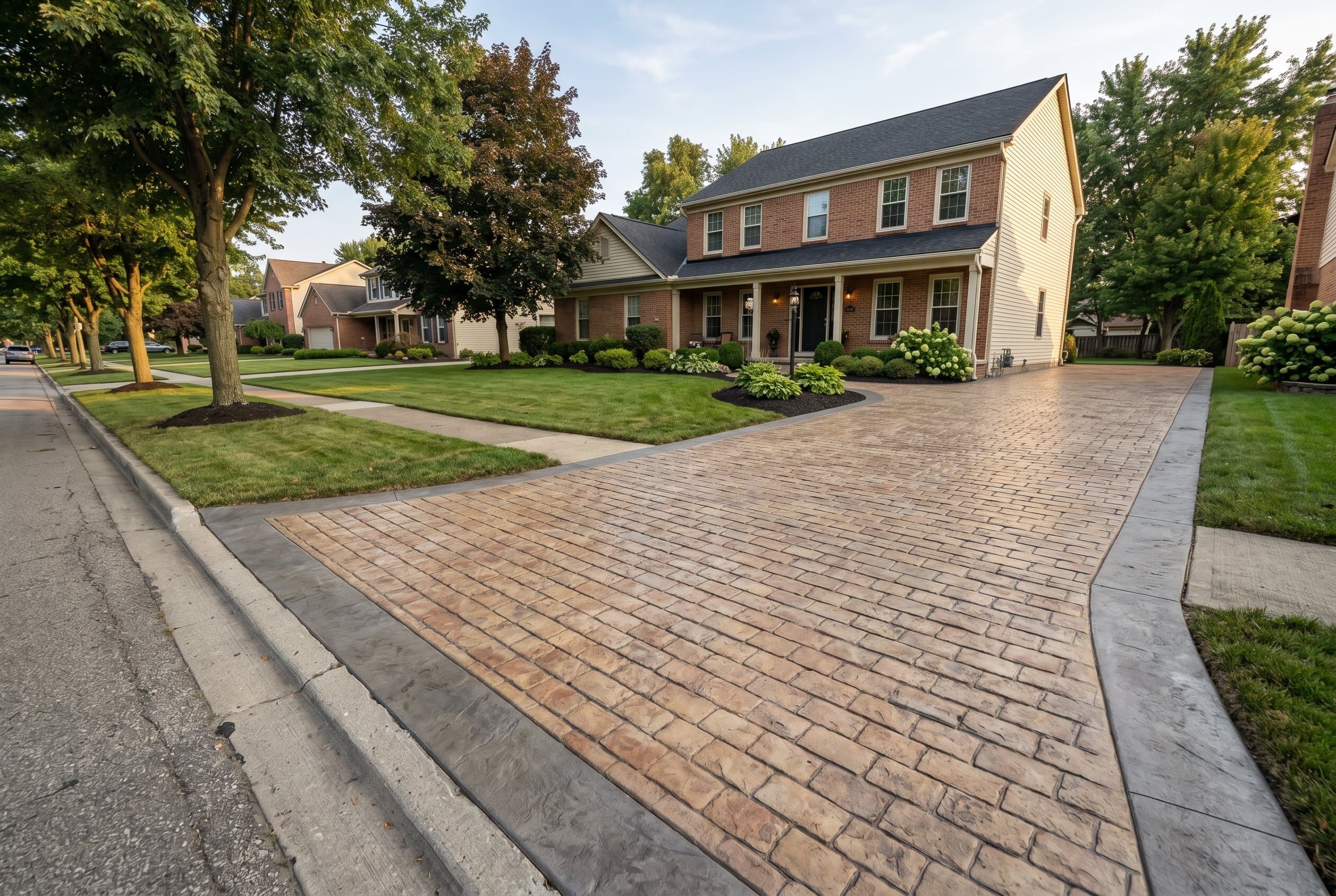
Stamped concrete driveway with cobblestone pattern in warm tones.
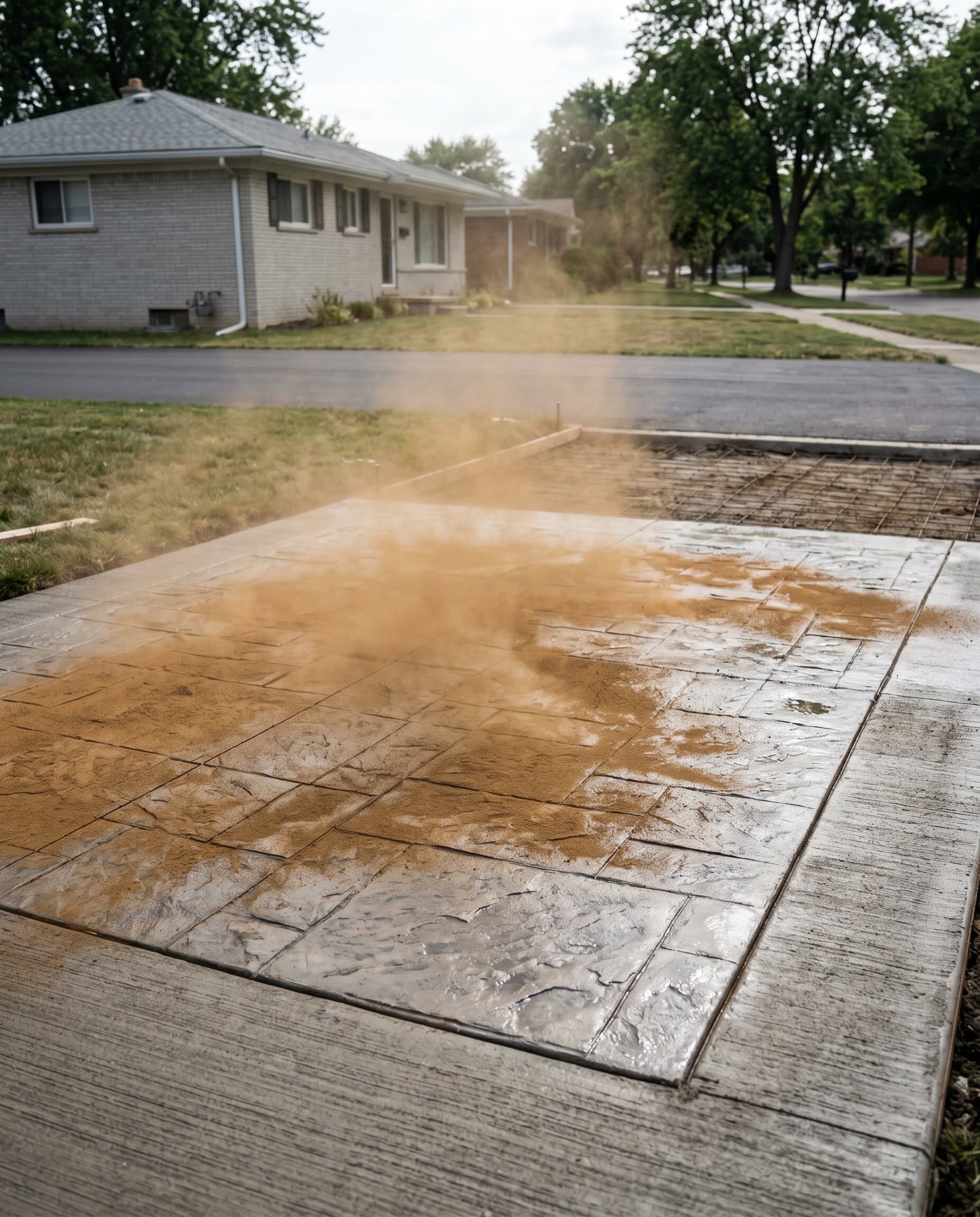
Color release powder broadcast over wet concrete before stamping.
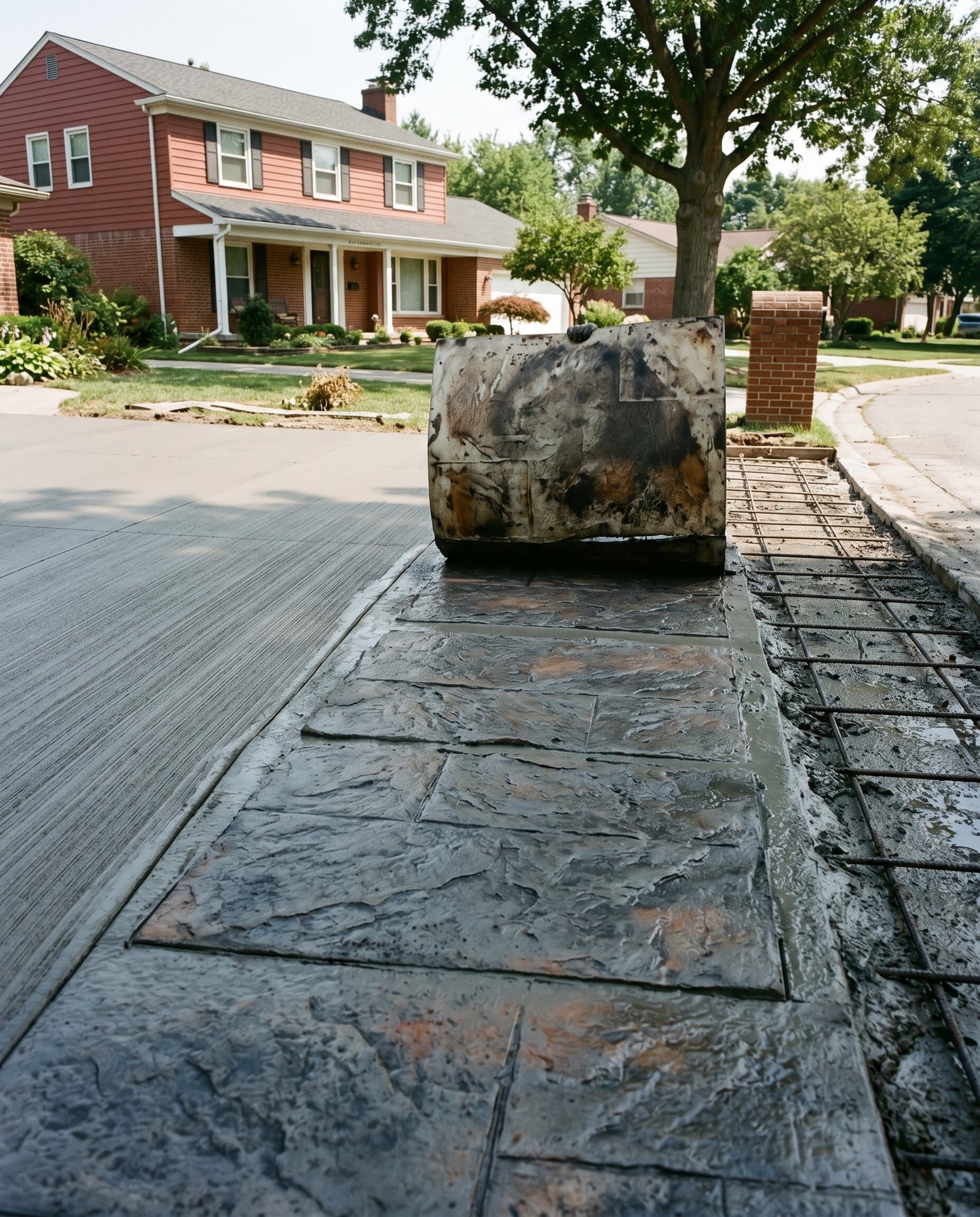
Stamping mat pressed into wet concrete with handle visible.
What we install

When a driveway should look like more than gray concrete

A stamped concrete driveway is a structural slab with a pattern pressed into the surface while the concrete is still plastic. A coloring step gives the slab the look of cobblestone, brick, slate, or natural stone. For a Sterling Heights homeowner spending money on a new driveway anyway, the upgrade to a stamped finish is often the curb appeal piece. It ties the whole front of the house together, especially when paired with a stamped walkway or porch. The structural slab underneath is the same 4 inch reinforced pour any concrete driveway gets in Michigan. Only the decorative finish changes.

The pour itself runs the standard sequence: base prep, forms, rebar, mix, screed, float. The decorative steps happen between the float and the cure. While the surface is still wet, a color hardener gets broadcast over the slab. The crew works it into the top quarter inch, which gives the field its base color. Then a release powder, a contrasting color, gets dusted over the surface. It keeps the stamp mats from sticking, and it settles into the recesses of the pattern for depth. The stamp mats then press the pattern into the slab in sequence. The crew advances the mats across the field. After cure, the slab gets washed to remove the loose release powder. A UV stable sealer locks in the colors and gives the wet-look sheen.

  • Same 4 inch reinforced 4,000 psi slab as a standard driveway, with a decorative finish on top.
  • Color hardener broadcast into the surface, not painted on after cure.
  • Contrasting color release sets the depth in the stamp recesses.
  • Borders and field can be different patterns (banding, soldier course, herringbone center).
  • UV stable sealer keeps the colors locked and gives the wet-look gloss.
The decorative color and pattern live in the slab itself. The sealer that gives the wet-look gloss is a 2 to 3 year maintenance item.

Stamped concrete works in Sterling Heights and the rest of Macomb County the same way it works anywhere else. There is one local consideration: the sealer is a maintenance item. The decorative color and stamp pattern are permanent. They live in the structure of the slab itself. But the sealer that gives the surface its wet-look sheen wears off in 2 to 3 years. It needs reapplication. Skipping the reseal does not damage the slab. It just lets the surface go matte over time. Reputable Sterling Heights contractors quote the install and the reseal schedule separately. That lets the homeowner understand the full cost over a decade.

For Sterling Heights homeowners considering a stamped concrete upgrade for a new driveway or a replacement, the form or the phone above goes to a local contractor with a sample board of patterns and color blends. A free walk through includes seeing the sample board in natural light on the property.
Materials

What stamped concrete is, in plain materials

A stamped concrete driveway sits on the same structural foundation as any driveway: a compacted limestone base, continuous rebar, and a 4 inch slab of 4,000 psi air-entrained concrete. None of the decorative steps replace those layers. The decorative process adds two materials and one tool. The color hardener is a dry powder. It contains portland cement, iron oxide pigment, and silica sand. The crew broadcasts it onto the wet slab and works it into the top quarter inch. The color release is a contrasting pigment powder. It keeps the stamp mats from sticking, and it adds depth in the pattern recesses. The stamp mats themselves are flexible polyurethane mats with a relief pattern cast into the underside.

The patterns available cover a wide range: random cobblestone, running bond brick, slate, ashlar, herringbone, wood plank, even leaf textures. For a Macomb County driveway, the most durable patterns are the ones with shallow relief, less than a quarter inch deep. Deeper relief catches snow shovel blades and chips off in winter. The most common Michigan driveway choice is a random cobblestone in a warm sandstone tone. It pairs with a contrasting smooth banded border. The combination holds up well to plow and shovel traffic. The least durable choice is a deep slate pattern with sharp ridges. The ridges spall off over a few winters.

  • Color hardener carries the field color and lives in the top quarter inch of the slab.
  • Color release pigment gives depth in the stamp recesses and prevents mat sticking.
  • Stamp mats press the pattern in while concrete is plastic; pattern is permanent after cure.
  • Sealer is the only decorative wear item and needs reapplication every 2 to 3 years.
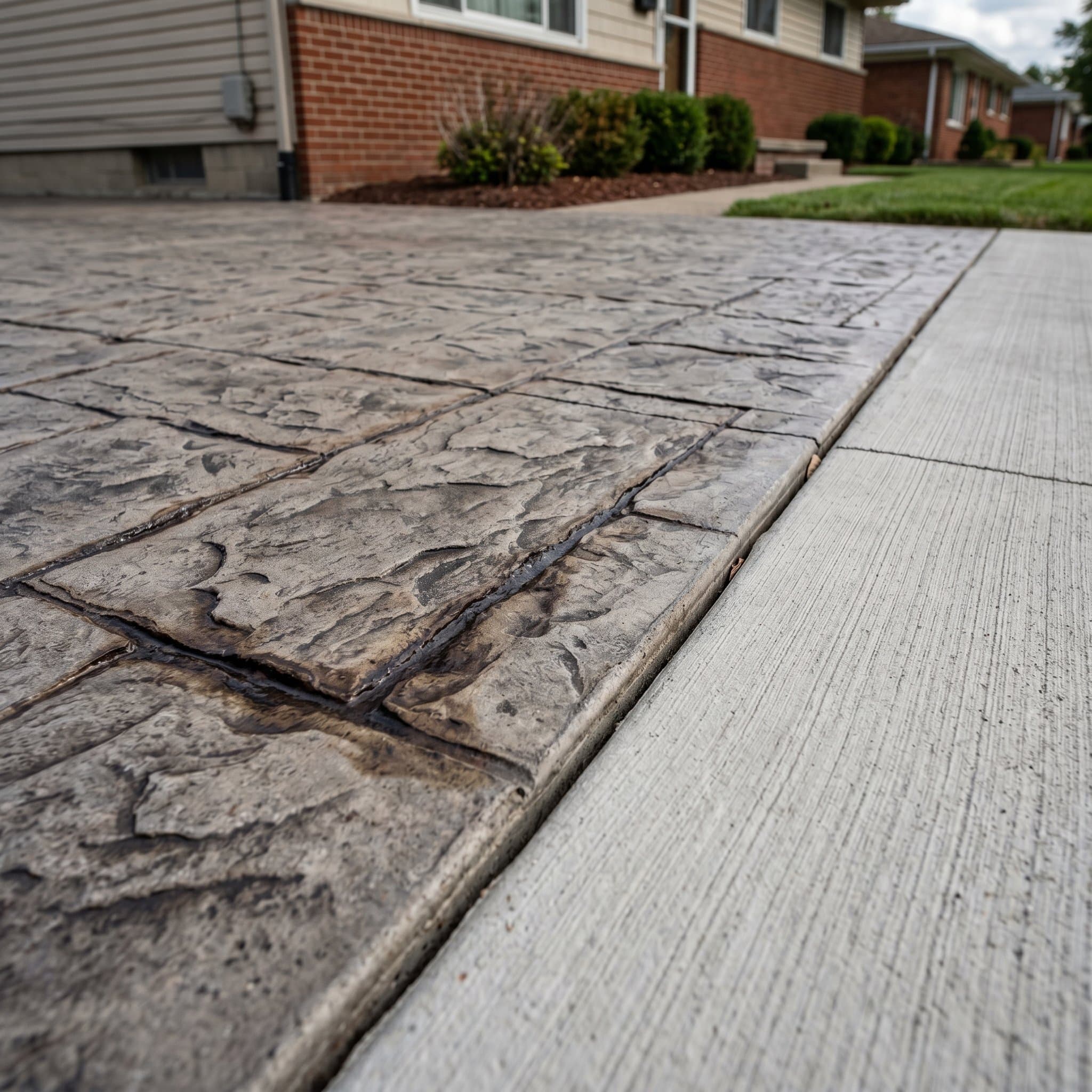
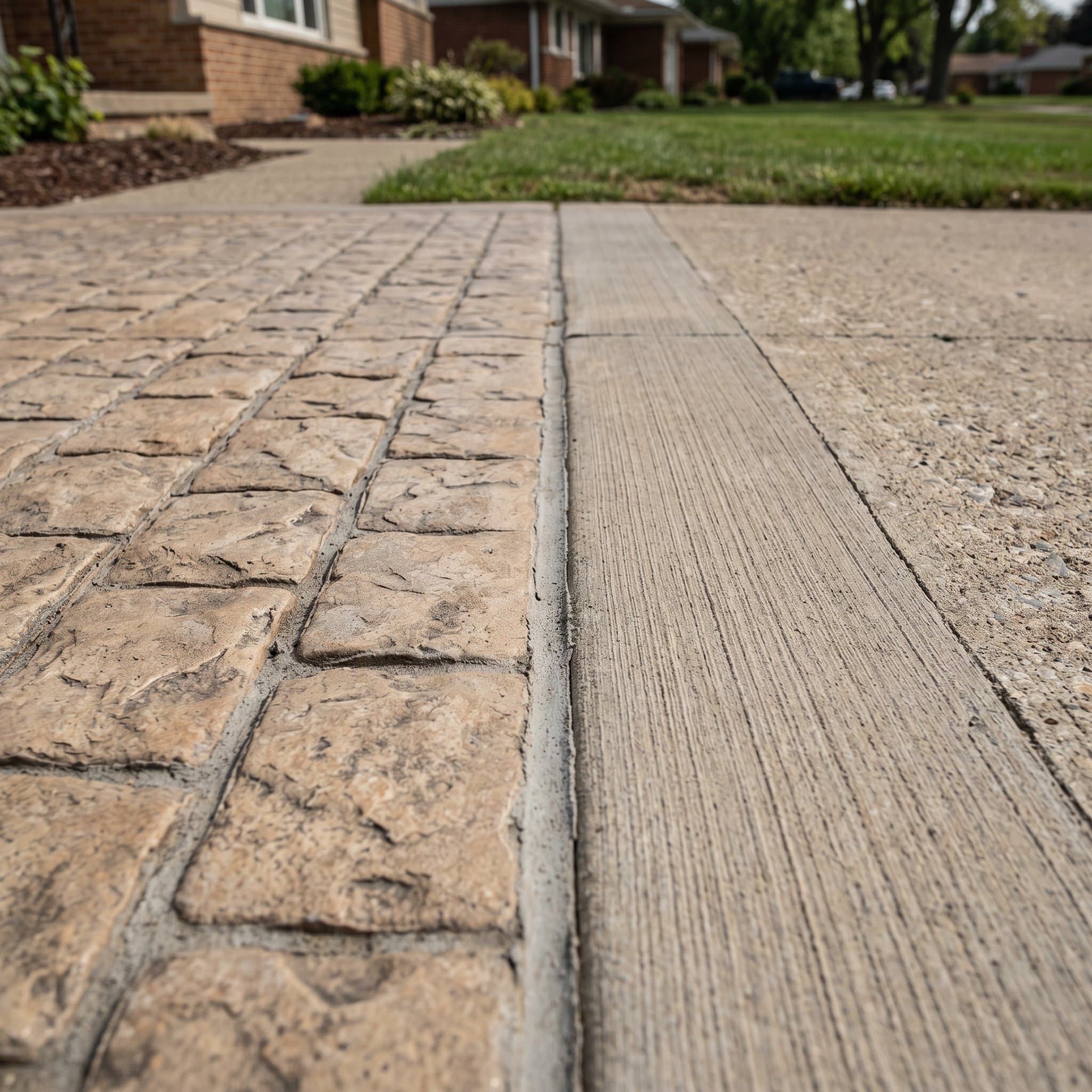
Close detail of stamped pattern showing mortar joint depth.
Smooth contrasting border banding around stamped concrete field.
What about the alternatives?

Stamped concrete versus other decorative driveway options

A Sterling Heights homeowner spending the money to upgrade curb appeal usually compares three options before settling. The honest version of how each one performs over 10 to 30 years in Michigan is below.

Plain broom finished concrete

Cheapest, most durable, least decorative. Looks fine but does nothing for curb appeal. The right choice for a homeowner who does not care about the look.

Recommended

Pavers or interlocking brick

Most premium look. Most expensive on day one. Most maintenance ongoing because the sand joints wash out and need refilling. Heaves on Michigan clay unless base is heavy.

Acceptable

Acid-stained concrete

Decorative color from acid reaction with the slab. Cheaper than stamped, more variable in result, no pattern just color. UV stability of the stain is the variable to watch over the years.

Acceptable

Painted concrete or concrete stain over an existing slab

Cheapest cosmetic. Paint wears off in 2 to 4 winters under tire traffic. Concrete stain over a poorly prepared slab also fails quickly.

Skip

Stamped concrete with integral color and sealer

Permanent pattern and color in the structural slab, with a maintenance sealer every 2 to 3 years. Looks like cobblestone or stone, lasts as long as a plain slab.

Recommended
How it goes

From quote to walk-on, fast.

01

Free walk-through

02

Tear-out and base prep

03

Forms, rebar, and pour

04

Finish and cure

Before you book

Things to confirm before booking a stamped concrete driveway

Stamped concrete attracts more variation in contractor quality than plain concrete, because the decorative finish either looks expensive or looks fake depending on the crew. The questions below catch that.

Can I see a completed stamped driveway, not just a sample board?
Yes. The contractor should provide one or two addresses for finished installs at least 2 to 3 years old. The homeowner can drive by and see how the slab and the sealer have aged. A contractor with no aged installs to show is either new or has reasons not to display the result. A sample board in a showroom shows the day one look. An aged install shows the year 3 look, which is the one that matters.
How is the color picked and how customizable is it?
Color hardener comes in roughly 30 standard colors from major suppliers like Brickform, Davis Colors, and Solomon. Blending is possible for custom tones. The release powder comes in a smaller range of complementary tones. The tones are picked to make the pattern recesses pop. Most contractors bring a physical sample of the chosen blend to the walk through. Some will pour a small test panel on the property before the full job. That lets the homeowner approve the look in natural light. Custom blending adds a small cost. Standard catalog colors do not.
How does stamped concrete hold up to snow plows and shovels?
Patterns with shallow relief (under a quarter inch deep) handle plow and shovel traffic well; deep relief patterns (slate ridges, deep brick joints) catch metal edges and chip over time. The honest contractor will steer a Michigan driveway client toward a moderate relief pattern (cobblestone, ashlar, brick) and away from deep relief. Salt is the other concern; deicer chemistry attacks the sealer faster than it attacks the slab, so plain sand for traction is better than salt in winters one and two.
Why does the sealer need reapplication, and what does that cost?
The sealer is a clear acrylic, water-based or solvent-based, that locks in the colors and gives the wet-look gloss. UV exposure and tire traffic wear it off over 2 to 3 years. Reapplication is a pressure wash, a dry day, and a recoat rolled across the slab; typical cost is a fraction of the original install, and most reputable contractors offer the reseal as a scheduled service. Skipping the reseal does not damage the slab; the colors stay in the concrete. The surface just goes matte instead of glossy.
Can stamped concrete be done as a replacement over a failing slab?
Yes, the same way any concrete driveway replacement works. The old slab gets torn out, the base gets rebuilt, the new slab gets poured with the decorative steps on top. Stamped concrete cannot be done as an overlay on an existing failing slab because the overlay thickness needed for stamping is more than a typical thin overlay supports. If the existing slab is structurally sound but ugly, a resurfacing service may be a better choice than stamping a thin overlay.
Aftercare

Keeping the stamped finish looking new for years

Stamped concrete needs the same structural maintenance as any concrete driveway, plus one decorative item: the sealer. Reseal every 2 to 3 years to keep the colors saturated and the wet-look gloss intact. Push snow with a poly blade. A metal edge scratches the sealer and chips the pattern ridges. Skip rock salt and calcium chloride deicers. They break the sealer down faster than UV does. Sand for traction is the safer winter choice. Watch the saw-cut joints for new openings. On a stamped driveway, those joints are placed along pattern transitions so they read as part of the design. Fill any that spread past a quarter inch with a polyurethane caulk that matches the field color.

  • Reseal every 2 to 3 years with a UV stable acrylic sealer matched to the original.
  • Push snow with a poly or rubber blade, never a metal edge that scrapes the sealer.
  • Use sand for winter traction; rock salt and calcium chloride wear the sealer down fast.
  • Watch the saw-cut joints (placed at pattern transitions) for openings, refill with matching polyurethane caulk.
  • Rinse off road grime in spring after the snow melts to remove accumulated deicer residue.
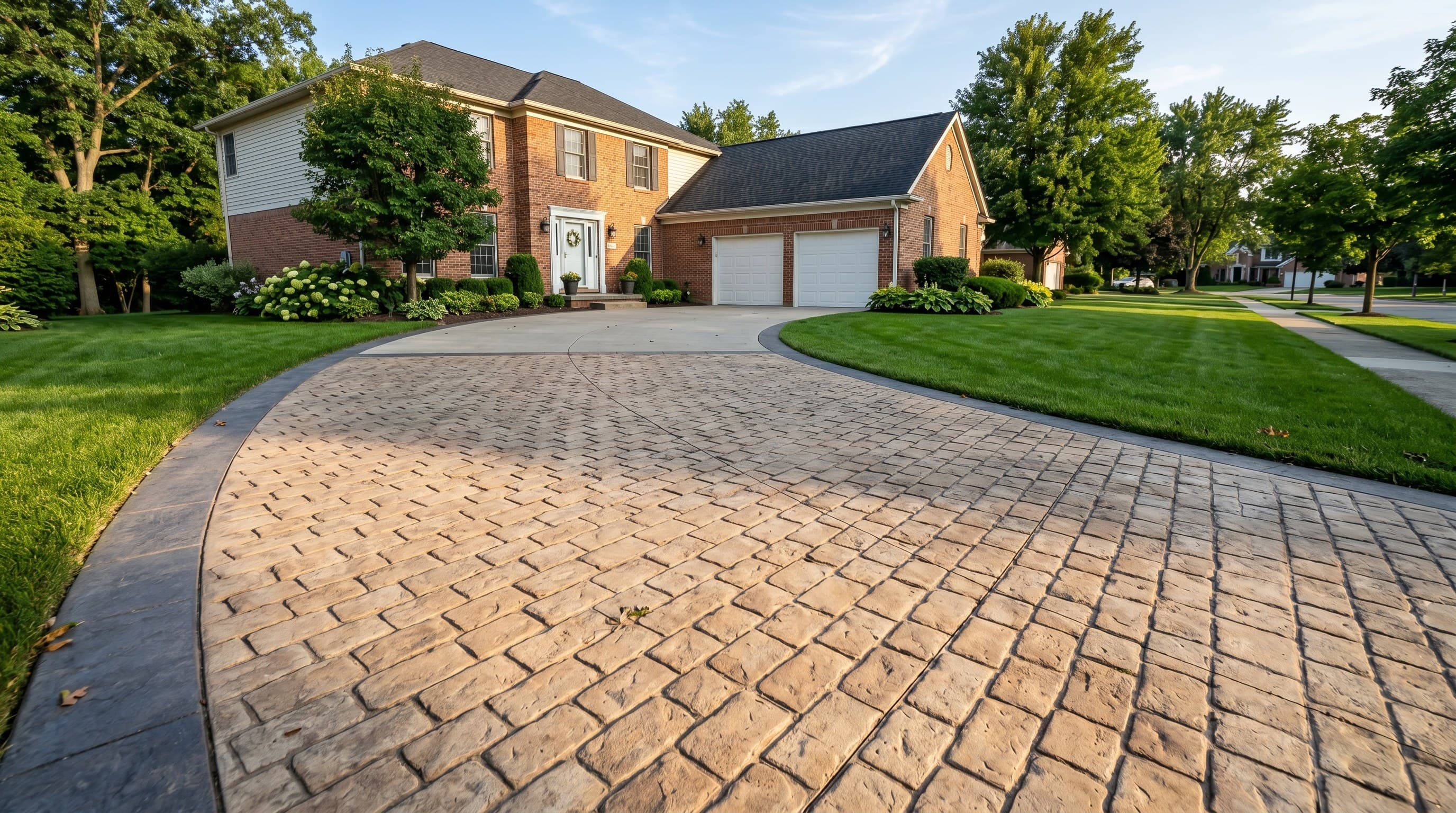
Finished stamped driveway leading to a colonial home.
FAQ

Common stamped concrete questions

How long does a concrete driveway last in Michigan?
A driveway poured to current Michigan Concrete Association spec (4 inch slab, continuous rebar, air-entrained 4,000 psi mix, saw-cut joints, compacted limestone base) lasts 30 years or more with light maintenance. Driveways poured to the lighter 3,000 psi spec common in the 1970s and 1980s often show surface spalling by year 25 and need replacement by year 35 to 45. The maintenance discipline that extends the slab the longest is a penetrating siloxane sealer applied every 2 to 3 years.
Can concrete be poured in winter in Michigan?
The active pour window in Michigan runs roughly May through October, because the slab needs 7 days above 50 degrees Fahrenheit to cure to design strength. Cold weather pours are possible with insulating blankets and accelerator admixtures, but they cost more and the schedule fills up fast in late winter. Most reputable contractors book May pours starting in March and stop taking new bookings for the season by mid-September. Inquiries that arrive in October or later typically schedule for the following spring.
Is concrete or asphalt better for a Michigan driveway?
Concrete lasts longer (30 plus years versus 15 to 20 for asphalt), needs less ongoing maintenance (a 2 to 3 year siloxane reseal versus a 2 to 4 year asphalt reseal that is more involved), and resists freeze and thaw spalling when poured to the right spec. Asphalt is cheaper on day one and quicker to install but softens in summer heat, needs more frequent resurfacing, and shows tire ruts in hot weather under the same parking pattern. Both work in Macomb County; concrete is the better value over the long run for an owner planning to stay in the house more than 10 years.
How much should a concrete driveway cost per square foot in Sterling Heights?
Market ranges for a residential driveway in Macomb County depend on the scope of base prep, demolition (for a replacement), and finish choice. Reputable contractors do not quote per square foot from the curb because the right number depends on the slab condition, the base condition, and the apron requirements. The honest path is a free 15 minute on-site walk through that produces a fixed written quote covering the demo, base, rebar, pour, and finish. Bids that quote a single per square foot number without seeing the slab tend to add costs once work starts.
How long until I can park on a new concrete driveway?
Foot traffic at 24 hours after the pour. Light vehicle (car or pickup) at 7 days. Heavy vehicle (RV, dump truck, full delivery) at 28 days, when the slab reaches design strength. Driving on a slab early does not always crack it immediately, but it leaves residual stress in the concrete that shows up as cracking a season or two later. Most homeowners park on the street for the first week and then carefully on the new slab after day 7.
Ready when you are

Ready for a real Sterling Heights floor?

Send a few photos or book a free 15-minute on-site walk-through. A fixed written quote within one business day.

Get a free quoteCall (586) 210-8999
CallFree Quote