New Concrete Driveway Installation · Sterling Heights

New Concrete Driveway Installation in Sterling Heights, MI

What a 4 inch reinforced slab poured to the Michigan Concrete Association spec actually looks like, start to finish.

1 to 2 days installs · typical timeline
Free Quote

Free New Concrete Driveway Installation quote.

We reply within 1 business hour. No spam, ever.

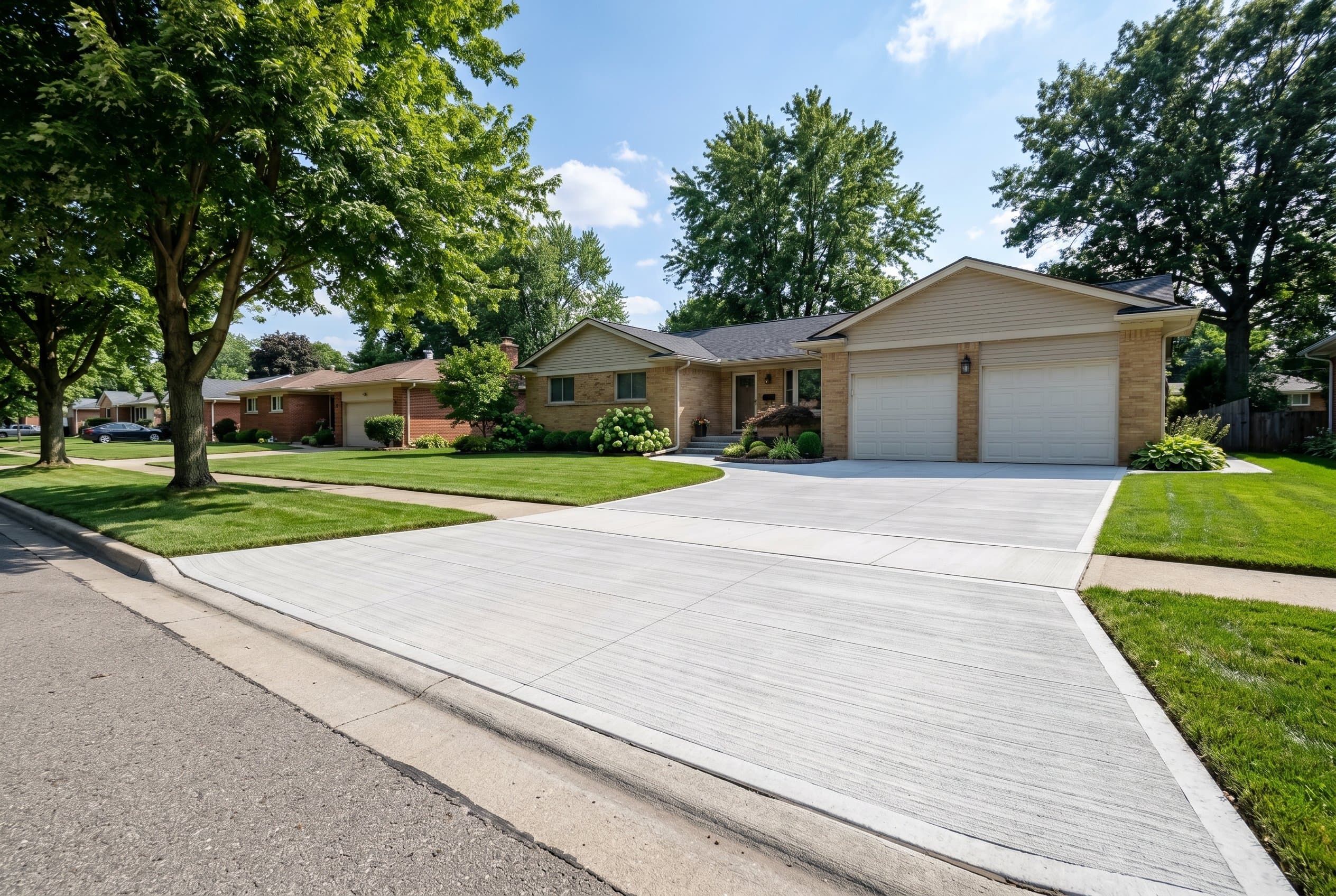
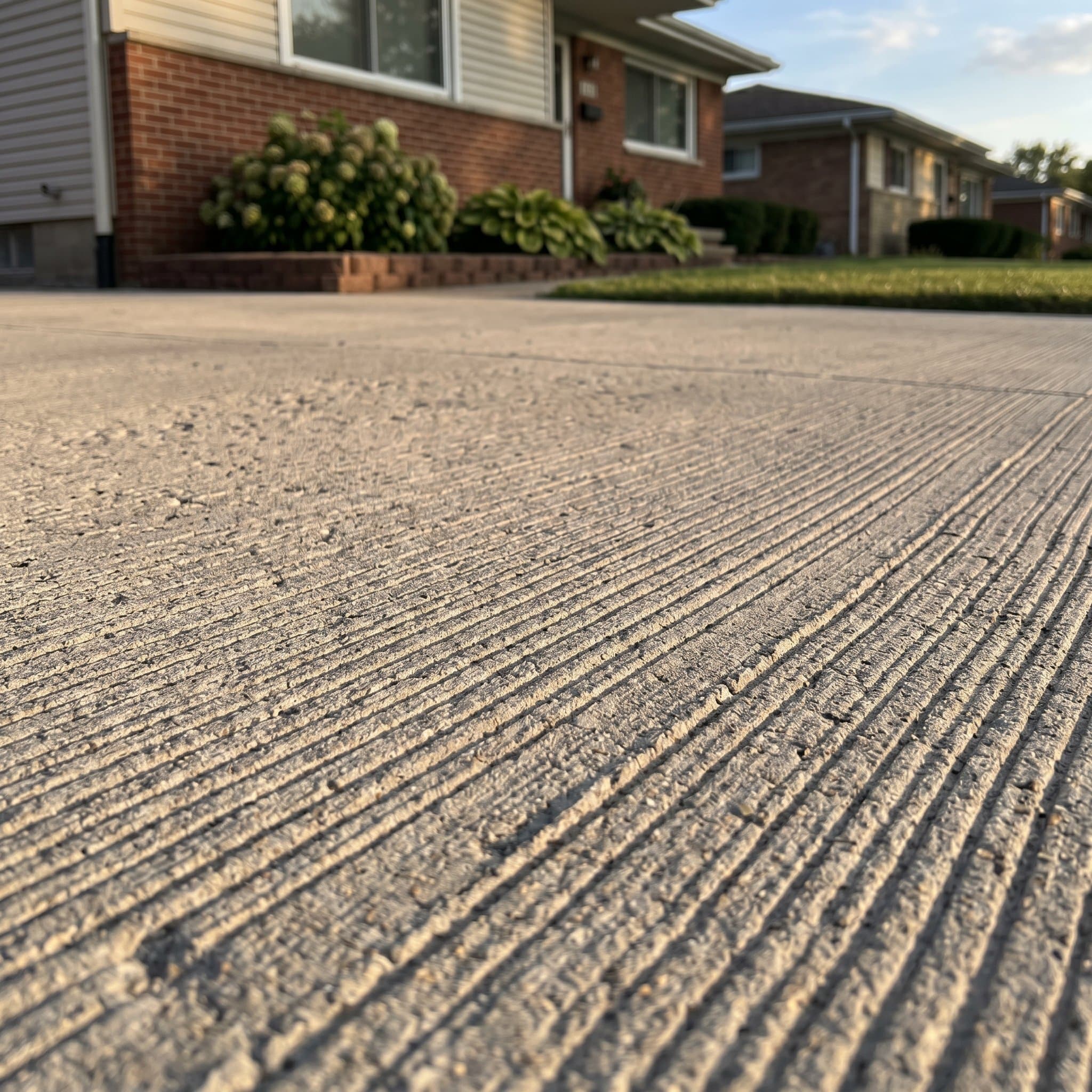
Finished new concrete driveway with broom finish texture.
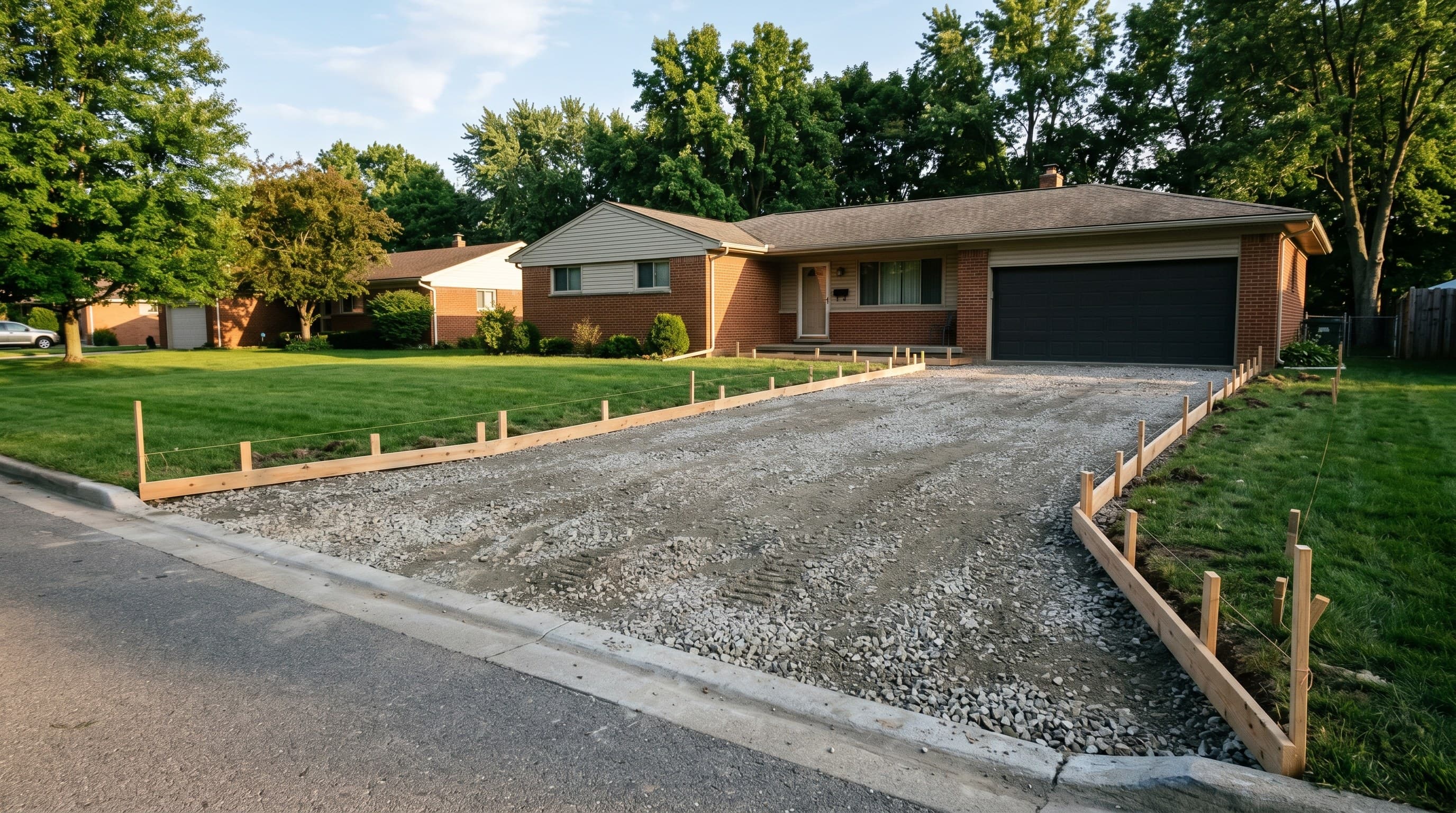
Compacted limestone base graded for a new driveway pour.
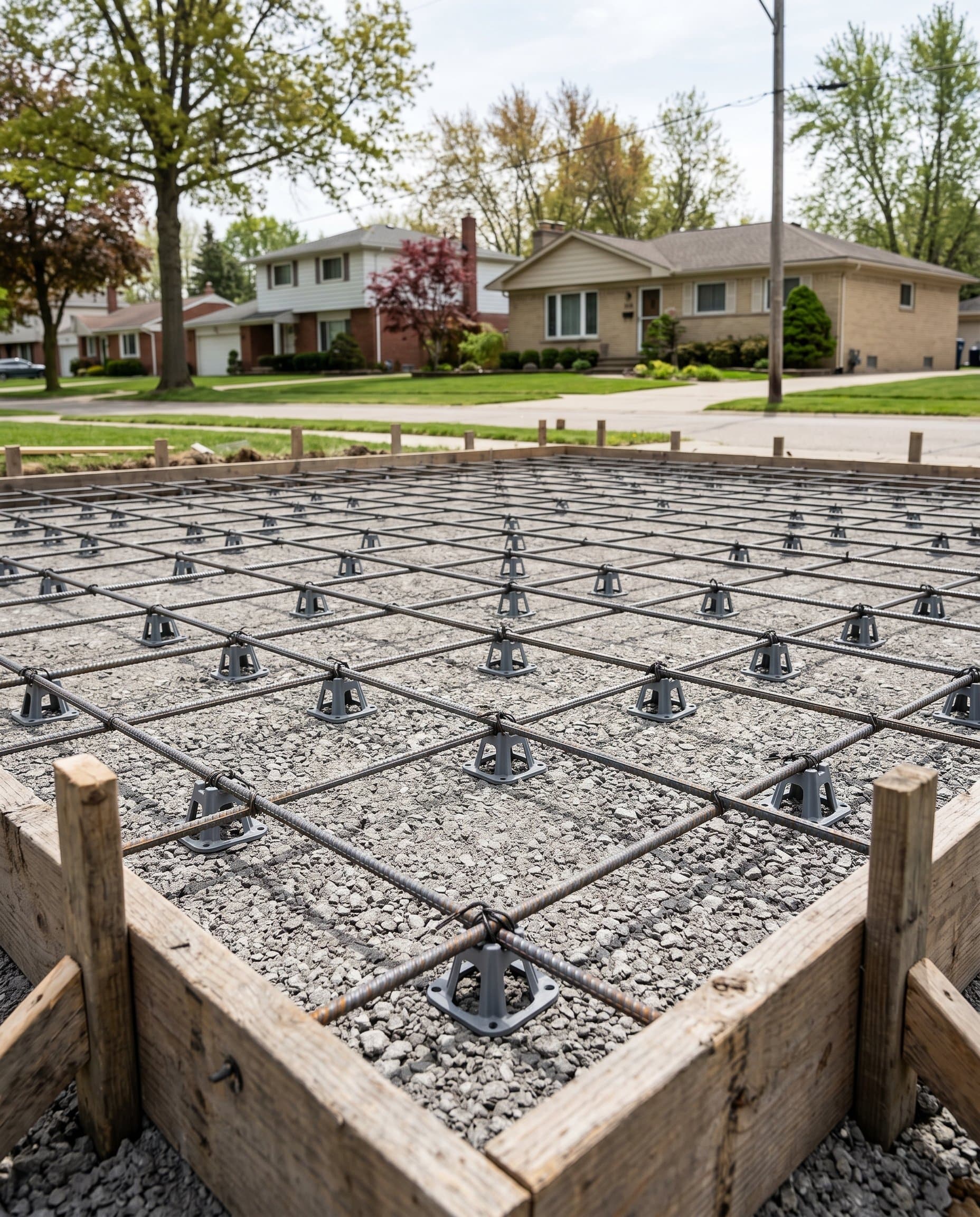
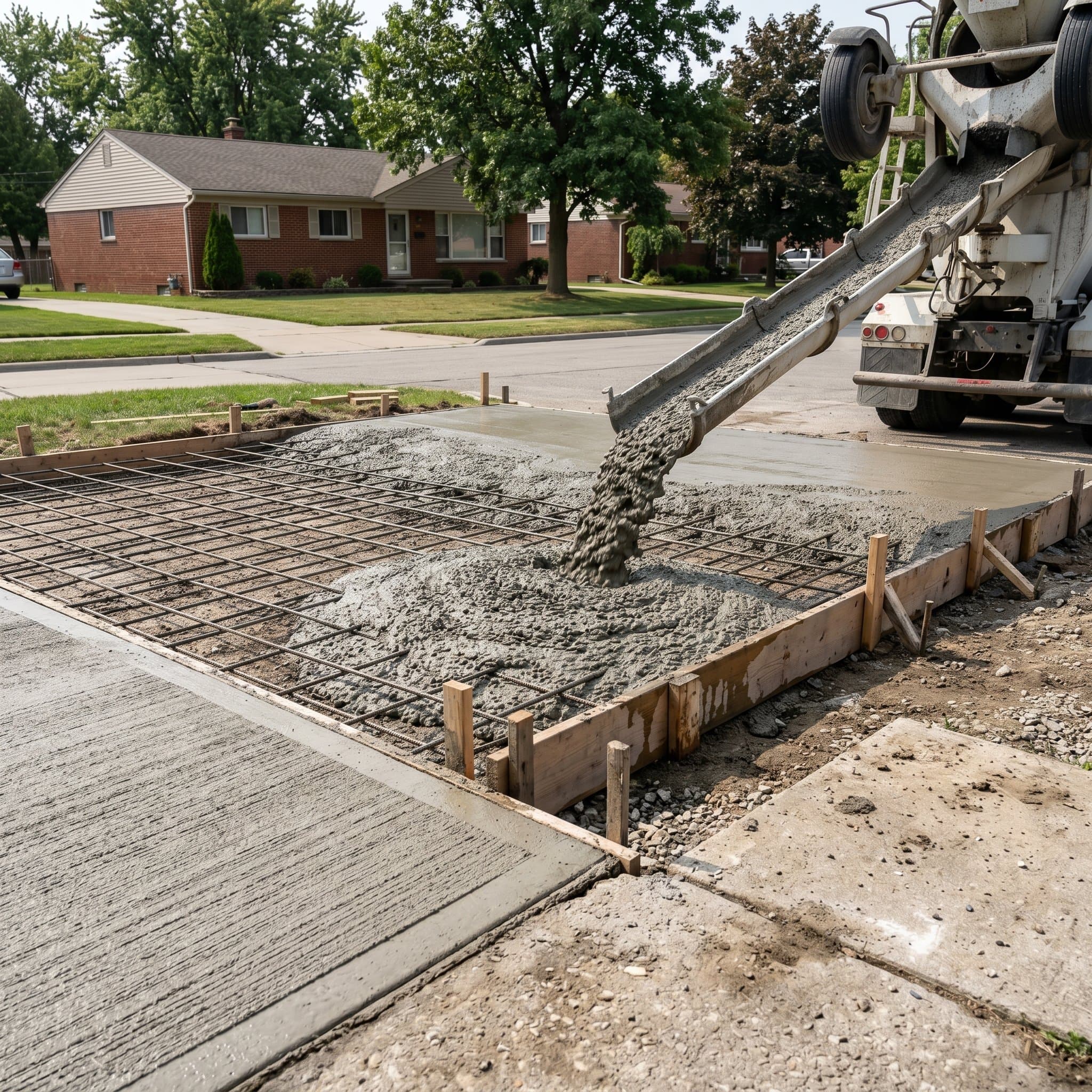
Continuous steel rebar grid tied off on chairs above base.
What we install

What goes into a new driveway that holds up in Michigan

Most Sterling Heights homeowners adding a new driveway start with one of three site conditions. Either bare dirt where a driveway never existed, a gravel pad that needs to be upgraded, or a finished lot in a new build that still needs the apron and run from the garage to the street. The site condition changes how much base prep is needed. But the slab spec stays the same. A residential driveway in Macomb County needs a 4 inch reinforced slab. The mix is air-entrained 4,000 psi. Saw-cut control joints sit on the right spacing. Anything less than that fails inside the first decade.

A proper new driveway pour runs in a clear sequence. First, the base gets graded with a slope away from the house, usually 1/4 inch per foot. 4 to 6 inches of crushed limestone goes down, compacted in lifts so it locks together. Forms set the edges and follow the apron grade. Continuous steel rebar gets tied off on chairs. The bar is typically 3/8 inch on an 18 inch grid. The chairs lift the steel so it sits in the middle of the slab where it does work. The pour uses an air-entrained mix at 4,000 psi minimum. Michigan freeze and thaw chips the surface off any leaner mix. After the pour gets floated smooth, a broom finish goes over the top for traction in winter. Control joints get saw-cut at one and a quarter times the slab thickness apart. That makes the slab crack where the contractor planned instead of randomly.

  • Air-entrained 4,000 psi mix that meets Michigan Concrete Association spec.
  • Continuous 3/8 inch steel rebar on an 18 inch grid, tied above the base.
  • Broom finish for grip, never glassy steel trowel that turns slick in rain.
  • Saw-cut control joints at the right spacing, never just tooled with a hand groover.
  • Compacted limestone base in lifts, the layer most cheap bids skip first.
Most driveways do not fail because the concrete was bad. They fail because the base was light or the slab was thin.

Sterling Heights and the surrounding Macomb cities (Warren, Roseville, Fraser, Clinton Township, Shelby Township, Utica, Macomb Township) all sit on the same heavy clay soil that wants to heave when the slab is poured too thin. Reputable contractors in this area write the slab thickness, the rebar spec, the psi number, and the joint spacing directly into the quote, not as a verbal promise. A bid that just says concrete driveway with a price is the one missing the layers that matter.

If the project is a brand new driveway on a Sterling Heights lot, the form or the phone number above goes to a local concrete contractor who handles the whole job, from base prep through the final broom finish. Free walk through and a fixed written quote inside one business day.
Materials

The four layers of a driveway pour, and why each one is there

The first layer is the base. It is the layer cheap bids cut first. The native soil under most Macomb County yards is clay. Clay expands when it gets wet and shrinks when it dries. A slab poured directly on raw clay flexes with the soil. It cracks within a year and tilts within five. A compacted limestone base, 4 to 6 inches deep, gives the slab a stable bed. It drains water away from the underside instead of trapping it against the concrete. The base also gets compacted in lifts. A few inches go down at a time, get rolled or tamped with a plate compactor, then the next lift goes on top. A base dumped in one shot and rolled once on top compacts only the top inch. That is why driveways on cheap base prep sink at the edges within three winters.

The second layer is the steel. Continuous rebar at 3/8 inch on an 18 inch grid spread across the slab does two jobs. It holds the slab together when shrinkage cracks form. Cracks form whether the control joint is there or not. The steel keeps the slab from separating at the crack and tilting one half against the other. The rebar also bridges the slab over any soft spot in the base that gets through the compaction step. The third layer is the concrete itself, an air-entrained 4,000 psi mix. The air-entrained part means tiny air bubbles get whipped into the mix at the plant. When water freezes inside the slab, it has room to expand without spalling the surface off. The fourth layer is the finish. The broom finish gives traction. Saw-cut joints at the right spacing handle crack control. At least 7 days of cure under wet burlap or a curing compound comes before any vehicle weight goes on the slab.

  • 4 to 6 inch crushed limestone base compacted in lifts, not dumped in one go.
  • Continuous 3/8 inch steel rebar on an 18 inch grid, tied above the base on chairs.
  • Air-entrained 4,000 psi mix that resists Michigan freeze and thaw spalling.
  • Broom finish for winter traction, saw-cut joints at 1.25 times the slab thickness.
Concrete truck chute pouring fresh mix into wooden forms.
Broom finish drag pulled across a freshly floated slab.
What about the alternatives?

What homeowners weigh against a poured concrete driveway

When adding a driveway, most Sterling Heights owners compare a couple of obvious alternatives before settling on the right one. The honest version of how each option performs in Macomb County is below.

Asphalt driveway

Cheaper on day one and quicker to install. Needs reseal every 2 to 4 years, softens in summer heat, lasts 15 to 20 years before a tear out.

Acceptable

Gravel driveway

Cheapest of all, very low maintenance, looks rural. Tracks gravel into the garage, ruts under the same tires every day, no real winter shoveling possible.

Acceptable

Pavers or interlocking brick

Most expensive of the four. Looks premium, fully repairable one paver at a time. Heaves on heavy clay soil unless the base prep goes deep.

Acceptable

Cheap thin concrete pour (3 inch, no rebar, 3,000 psi)

Looks identical to a real driveway on day one. Cracks heavily by year 3, spalls by year 5, fails inside a decade.

Skip

Standard 4 inch reinforced concrete driveway

The job described above. Air-entrained 4,000 psi on a compacted limestone base. Lasts 30 years or more with light maintenance.

Recommended
How it goes

From quote to walk-on, fast.

01

Free walk-through

02

Tear-out and base prep

03

Forms, rebar, and pour

04

Finish and cure

Before you book

Things to confirm before signing a new driveway contract

Reputable concrete contractors in Sterling Heights will answer all of these directly in the on-site walk through. If a bidder pushes back on any of them, that is the signal to keep looking.

How deep is the base and what material is it?
4 to 6 inches of crushed limestone (sometimes called 21AA or 22A in Michigan), compacted in two or three lifts with a plate compactor or vibratory roller. Pea gravel is not a substitute, native clay is not a substitute, and a single 2 inch lift dumped and rolled once on top is not a substitute. The base spec belongs in the written quote, not as a verbal promise.
What is the slab thickness and the rebar spec?
4 inches minimum for a residential driveway. Continuous 3/8 inch steel rebar on an 18 inch grid is the Michigan standard. Wire mesh laid flat on the base is not equivalent, even though some bids substitute it to save money. The mesh has to be lifted with chairs to sit in the middle of the slab to do any work, which is rarely done correctly in practice.
Why does the mix need to be 4,000 psi if 3,000 psi is cheaper?
The Michigan Concrete Association specifies 4,000 psi at 28 days for exterior flatwork subject to freeze and thaw, because the higher psi mix has the density and air-entrained pore structure that resists surface spalling when water freezes inside the slab. 3,000 psi works fine in mild climates. In Macomb County it pits the surface off in 5 to 7 years.
When can we actually park on the new driveway?
Foot traffic at about 24 hours after the pour. Light vehicle (car or pickup) at 7 days. Heavy vehicle (RV, dump truck, full delivery) at 28 days, when the slab reaches design strength. Driving on a slab early does not always crack it immediately, but it leaves stress that shows up as cracking a season or two later.
What time of year is the pour scheduled?
The active pour window in Michigan runs roughly May through October, because the slab needs 7 straight days above 50 degrees Fahrenheit to cure to design strength. Cold weather pours are possible with insulating blankets and accelerator admixtures, but they cost more and the schedule fills up fast. Booking the walk through in March or April for a May pour is the smoothest path.
Aftercare

How a new driveway stays a 30 year driveway

A residential concrete driveway needs very little after the pour cures. But the few things it needs are not optional. Seal the slab with a penetrating siloxane sealer in the spring after the first full winter. Reseal every 2 to 3 years to keep road salt from soaking in. Watch the saw-cut joints. The slab is designed to crack at those joints first. If anything looks wider than a quarter inch or starts to spread, get the joint filled with polyurethane caulk. Otherwise water gets under the slab and freezes. Push snow rather than chip it with a metal blade. Metal blades chase the broom finish off and start a spalling cycle. Keep deicer chemistry as far from the slab as practical, especially in years one and two. The concrete is still gaining strength in that window.

  • Seal with a penetrating siloxane sealer in spring after the first winter, reseal every 2 to 3 years.
  • Fill any joint that opens past a quarter inch with a polyurethane joint caulk before the next freeze.
  • Push snow with a poly blade or rubber edge, never a metal edge that scuffs the broom finish.
  • Keep rock salt and calcium chloride deicers off the slab in winters one and two while the concrete is still gaining final strength.
  • Watch for new cracks outside the saw-cut control joints. A crack that opens away from a joint signals a base or rebar issue that needs the original contractor back.
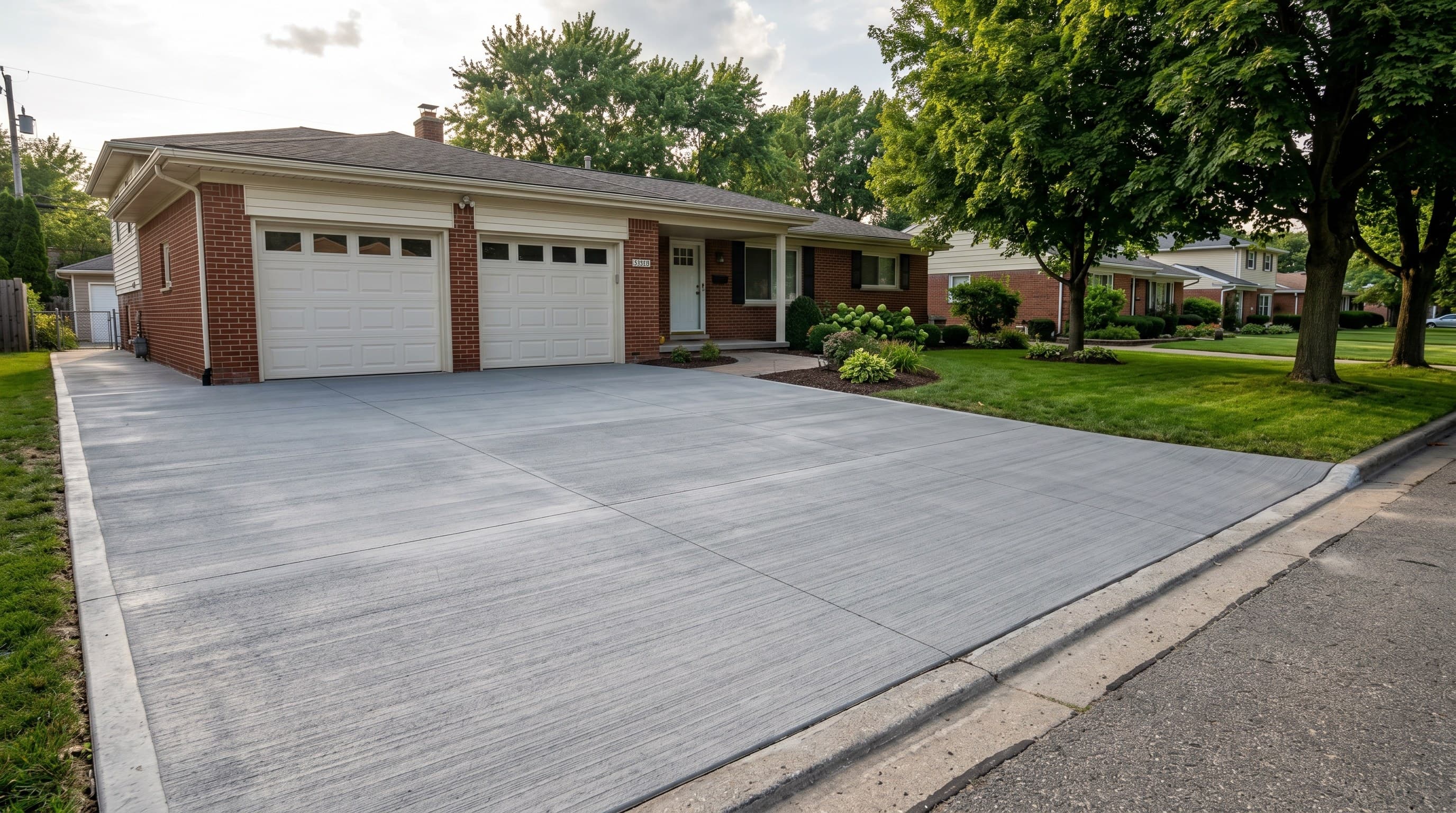
Wide finished driveway leading to a residential two car garage.
FAQ

Questions Sterling Heights homeowners ask about new driveways

How long does a concrete driveway last in Michigan?
A driveway poured to current Michigan Concrete Association spec (4 inch slab, continuous rebar, air-entrained 4,000 psi mix, saw-cut joints, compacted limestone base) lasts 30 years or more with light maintenance. Driveways poured to the lighter 3,000 psi spec common in the 1970s and 1980s often show surface spalling by year 25 and need replacement by year 35 to 45. The maintenance discipline that extends the slab the longest is a penetrating siloxane sealer applied every 2 to 3 years.
Can concrete be poured in winter in Michigan?
The active pour window in Michigan runs roughly May through October, because the slab needs 7 days above 50 degrees Fahrenheit to cure to design strength. Cold weather pours are possible with insulating blankets and accelerator admixtures, but they cost more and the schedule fills up fast in late winter. Most reputable contractors book May pours starting in March and stop taking new bookings for the season by mid-September. Inquiries that arrive in October or later typically schedule for the following spring.
Is concrete or asphalt better for a Michigan driveway?
Concrete lasts longer (30 plus years versus 15 to 20 for asphalt), needs less ongoing maintenance (a 2 to 3 year siloxane reseal versus a 2 to 4 year asphalt reseal that is more involved), and resists freeze and thaw spalling when poured to the right spec. Asphalt is cheaper on day one and quicker to install but softens in summer heat, needs more frequent resurfacing, and shows tire ruts in hot weather under the same parking pattern. Both work in Macomb County; concrete is the better value over the long run for an owner planning to stay in the house more than 10 years.
How much should a concrete driveway cost per square foot in Sterling Heights?
Market ranges for a residential driveway in Macomb County depend on the scope of base prep, demolition (for a replacement), and finish choice. Reputable contractors do not quote per square foot from the curb because the right number depends on the slab condition, the base condition, and the apron requirements. The honest path is a free 15 minute on-site walk through that produces a fixed written quote covering the demo, base, rebar, pour, and finish. Bids that quote a single per square foot number without seeing the slab tend to add costs once work starts.
How long until I can park on a new concrete driveway?
Foot traffic at 24 hours after the pour. Light vehicle (car or pickup) at 7 days. Heavy vehicle (RV, dump truck, full delivery) at 28 days, when the slab reaches design strength. Driving on a slab early does not always crack it immediately, but it leaves residual stress in the concrete that shows up as cracking a season or two later. Most homeowners park on the street for the first week and then carefully on the new slab after day 7.
Ready when you are

Ready for a real Sterling Heights floor?

Send a few photos or book a free 15-minute on-site walk-through. A fixed written quote within one business day.

Get a free quoteCall (586) 210-8999
CallFree Quote